![[personal profile]](https://www.dreamwidth.org/img/silk/identity/user.png) sebenikela
sebenikelaI grew up on stories of the Dust Bowl.
My dad’s parents were Okies–environmental refugees, before anyone had a word for it. They left their families, the land they were renting, their animals, took their 1-year-old daughter, and drove to California. My grandpa worked in a peach packing plant. My grandma cleaned houses.
They were so lonely that after a couple years they went back to Oklahoma, with their total savings of $20. Later, they bought land. Built a house. Survived.
My mom’s dad was a kid then, and his family stayed in western Kansas. Stayed because my great-grandpa was too damn stubborn to leave, stayed when their neighbors had all left, stayed because they didn’t have enough money to leave. They slept with wet rags over their faces. My great-grandpa tied a string around his waist, tied the other end to the house, and went to check on the cows, while my great-grandma tried to make soup from a little milk and a little flour. There was so much dust swirling in the air, the soup turned to mud. She cried, begged her husband once more to let them leave, and they went to bed hungry.
My grandpa’s oldest brother was the first one in the county to leave his wheat stubble in the field instead of plowing it under after the harvest. His neighbors made fun of him. His parents scolded him for having messy fields. 70 years later, at his funeral, someone told how people from Japan came to visit the farm, to see what he was doing differently.
More than 80 years after the Dust Bowl, I stood on a mountain in Ecuador watching, horrified, as a man with a tractor plowed a steep field. He would back up the hill, set the disk in the ground at the top of the field, and drive down, breaking up the soil, dragging it downhill. Dust billowed around him.
The man next to me, a rich-for-the-area farmer, sighed happily. “Look at all that dust. Isn’t that great?”
“What? No!” I was shocked.
“Why not? That’s what a modern farm looks like.”
I thought of the old black-and-white photos, dust clouds like black walls rolling in across the prairie. That’s what a modern farm looked like, too.
The next field down, four people and four oxen–well, dairy cows used as oxen–were planting. They used plows, too, but instead of a disk pulverizing the soil, their plow was a straight piece of wood, metal from an old leaf spring bolted to the end. One team of oxen used that plow to open a furrow, the women walking behind dropped maize seeds into the soil, and the second team of oxen dragged the same kind of plow just above the first, closing the furrow and burying the seeds. They walked along the hill–side to side, furrows running along the contour of the hill. If they were raising any dust, it wasn’t enough for me to see from across the valley.
The man with the tractor probably finished in an hour or two. The whole group, people and oxen and all, probably spent the whole day planting the same size field.
As the maize grew tall, you could see the difference: In the tractored field, the top rows were yellow, spindly, trying to root in the yellow-brown clay the topsoil had once covered. Down below, in dark, rich earth, the maize was tall, green, strong.
In Mali, years later, a farmer explained to a group of visiting scientists why, despite having made erosion control bunds, his rows of maize still went up and down the slope, instead of along the contour, parallel with the bunds. “Because of the wind,” he said, like it was obvious–because it was. In the rainy season, the wind comes from the south, and when storms come it blows hard enough to send dust and dishes and clothes left on the line flying and tumbling with it.
The rows of maize have to be parallel to that wind, or they’ll blow over. So sure, you can put the scientists’ earthen ridges in to block the downhill flow of water, but your rows can’t follow that meandering contour. Your rows have to face into the wind.
For thousands of years we’ve been coaxing, wrestling, dragging our food from the soil. If we’re careful, and lucky, we can make our peace with it. If we charge into places unknown–the high plains of Kansas and Oklahoma, the steep slopes of the Andes, the storm-swept fields of West Africa–if we plow, and plant, and harvest without thinking? Without learning from the place? Dust clouds blackening the horizon, stunted maize on worn-out soil, crops blown down in thunderstorms–the earth is forgiving, but only so far. We have time to learn, to make mistakes, to do what is easy even when it does harm, but only so much. Beyond that, we destroy the very literal foundations of our lives.
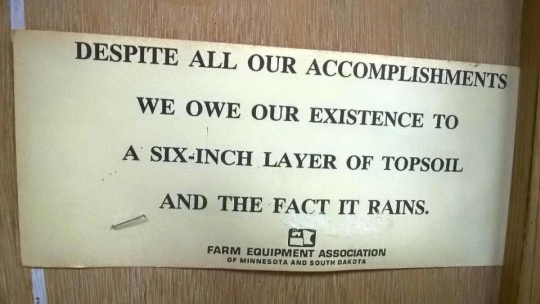
My dad’s parents were Okies–environmental refugees, before anyone had a word for it. They left their families, the land they were renting, their animals, took their 1-year-old daughter, and drove to California. My grandpa worked in a peach packing plant. My grandma cleaned houses.
They were so lonely that after a couple years they went back to Oklahoma, with their total savings of $20. Later, they bought land. Built a house. Survived.
My mom’s dad was a kid then, and his family stayed in western Kansas. Stayed because my great-grandpa was too damn stubborn to leave, stayed when their neighbors had all left, stayed because they didn’t have enough money to leave. They slept with wet rags over their faces. My great-grandpa tied a string around his waist, tied the other end to the house, and went to check on the cows, while my great-grandma tried to make soup from a little milk and a little flour. There was so much dust swirling in the air, the soup turned to mud. She cried, begged her husband once more to let them leave, and they went to bed hungry.
My grandpa’s oldest brother was the first one in the county to leave his wheat stubble in the field instead of plowing it under after the harvest. His neighbors made fun of him. His parents scolded him for having messy fields. 70 years later, at his funeral, someone told how people from Japan came to visit the farm, to see what he was doing differently.
More than 80 years after the Dust Bowl, I stood on a mountain in Ecuador watching, horrified, as a man with a tractor plowed a steep field. He would back up the hill, set the disk in the ground at the top of the field, and drive down, breaking up the soil, dragging it downhill. Dust billowed around him.
The man next to me, a rich-for-the-area farmer, sighed happily. “Look at all that dust. Isn’t that great?”
“What? No!” I was shocked.
“Why not? That’s what a modern farm looks like.”
I thought of the old black-and-white photos, dust clouds like black walls rolling in across the prairie. That’s what a modern farm looked like, too.
The next field down, four people and four oxen–well, dairy cows used as oxen–were planting. They used plows, too, but instead of a disk pulverizing the soil, their plow was a straight piece of wood, metal from an old leaf spring bolted to the end. One team of oxen used that plow to open a furrow, the women walking behind dropped maize seeds into the soil, and the second team of oxen dragged the same kind of plow just above the first, closing the furrow and burying the seeds. They walked along the hill–side to side, furrows running along the contour of the hill. If they were raising any dust, it wasn’t enough for me to see from across the valley.
The man with the tractor probably finished in an hour or two. The whole group, people and oxen and all, probably spent the whole day planting the same size field.
As the maize grew tall, you could see the difference: In the tractored field, the top rows were yellow, spindly, trying to root in the yellow-brown clay the topsoil had once covered. Down below, in dark, rich earth, the maize was tall, green, strong.
In Mali, years later, a farmer explained to a group of visiting scientists why, despite having made erosion control bunds, his rows of maize still went up and down the slope, instead of along the contour, parallel with the bunds. “Because of the wind,” he said, like it was obvious–because it was. In the rainy season, the wind comes from the south, and when storms come it blows hard enough to send dust and dishes and clothes left on the line flying and tumbling with it.
The rows of maize have to be parallel to that wind, or they’ll blow over. So sure, you can put the scientists’ earthen ridges in to block the downhill flow of water, but your rows can’t follow that meandering contour. Your rows have to face into the wind.
For thousands of years we’ve been coaxing, wrestling, dragging our food from the soil. If we’re careful, and lucky, we can make our peace with it. If we charge into places unknown–the high plains of Kansas and Oklahoma, the steep slopes of the Andes, the storm-swept fields of West Africa–if we plow, and plant, and harvest without thinking? Without learning from the place? Dust clouds blackening the horizon, stunted maize on worn-out soil, crops blown down in thunderstorms–the earth is forgiving, but only so far. We have time to learn, to make mistakes, to do what is easy even when it does harm, but only so much. Beyond that, we destroy the very literal foundations of our lives.
no subject
Date: 2019-09-12 01:04 pm (UTC)Here in Australia, our soil is much much older and more nutrient-poor than the rest of the world - because unlike the rest of the world, it didn't get scraped clean by the last ice age.
We have such, such fragile soil here.
My city, Perth, is a sand plain - the most common top soil here is water-repellant sand. Water runs straight off it unless you use soil-wettening agents or mulch.
If you manage to get water to penetrate the top soil, it sinks straight down to the water table unless you have mulched.
Several times between 2003 and 2019 Australia has had unusual-for-Australia episodes of Mad-Max style dust storms, where red inland soil blew as far as SYDNEY, which is right on the coast.
They've been so dramatic and so unusual that they have made the news each time that they happened.
In some cases, the soil carried novel bacteria, which meant that people got food poisoning from eating rockmelons [cantaloupes] and other fresh produce.
https://www.abc.net.au/news/2019-02-14/10812334
Contributing factors include:
unusually low rainfall due to climate change;
excessive tree-clearing;
mining;
weather.
no subject
Date: 2019-09-12 01:09 pm (UTC)no subject
Date: 2019-09-12 01:53 pm (UTC)for reference, these are some of the Dust Bowl photos (at the bottom of the page) https://www.weather.gov/oun/events-19350414-maps
It's interesting--CSIRO and other Aus ag research stuff does a lot of good work in southern Africa, because a lot of those soils are ALSO super old and hard to farm, and unlike the US/EU ag industry, Australians have some experience with that.
no subject
Date: 2019-09-12 02:01 pm (UTC)no subject
Date: 2019-09-12 02:03 pm (UTC)no subject
Date: 2019-09-12 02:06 pm (UTC)https://www.abc.net.au/news/2019-08-08/dust-storm-at-blanchetown-in-south-australia/11396884
no subject
Date: 2019-09-12 02:10 pm (UTC)https://www.youtube.com/watch?v=IHXVh8aMlHo
no subject
Date: 2019-09-12 01:41 pm (UTC)no subject
Date: 2019-09-12 11:32 pm (UTC)and yeah, pretty much anywhere you have Dry and Farming you're in a precarious position, so Australia for sure is there.
no subject
Date: 2019-09-14 11:09 am (UTC)no subject
Date: 2019-09-16 08:12 pm (UTC)no subject
Date: 2019-10-03 10:04 pm (UTC)I try not to rage, because the rage does no good. But sometimes it's impossible not to be angry at the sheer fucking arrogance of my ancestors.
no subject
Date: 2019-10-07 03:30 pm (UTC)the sheer fucking arrogance of my ancestors
YUP
the whole system of "we will burn through this ecosystem's buffering capacity and then be confused when shit stops working right" is uh, A Problem.